





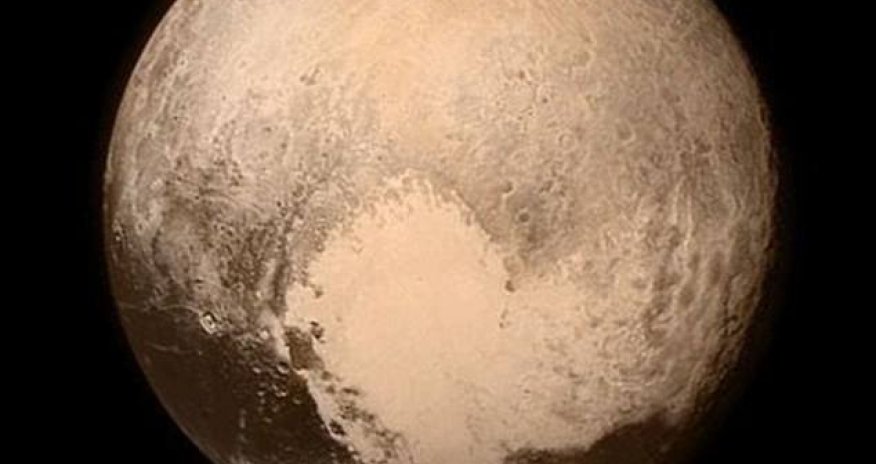
Humanity has visited Pluto for the first time...and captured this INCREDIBLE image
15.07.2015 19:00


Nasa has confirmed its New Horizons probe worked flawlessly on its flight past Pluto - and is now set to begin sending back images that will unravel the mystery of the dwarf planet's strange features.
The New Horizons probe flew past the dwarf planet at 7:49 a.m. EDT (11:49 GMT) this morning, capturing history's first close look at the distant world.
During its closest approach, the spacecraft came to within 7,800 miles (12,500km) of Pluto's icy surface, travelling at 30,800 mph (49,600 km/h).
Alice Bowman of Nasa, who was given the mission nickname Mom, confirmed the space agency had regained contact with the craft's signal, received at a station in Madrid at 8:55PM EDT.
'We are in lock with telemetry of the spacecraft,' she said to rapturous applause from the assembled scientists at mission control.
'Mom, nominal status, no rules have fired,' controllers reported.
'Looks like we have a good data connection. all hardware is healthy.'
I can't express this, I'm shaking,' she said.
'It worked just how we practised, we did it!'
'I know today we've inspired a whole new generation of explorers with this great success, and we look forward to the discoveries yet to come,' NASA Administrator Charles Bolden said.
'This is a historic win for science and for exploration. We've truly, once again raised the bar of human potential.'
'It's truly a mark in human history,' said John Grunsfeld, Nasa's associate administrator for science from the mission control center at Johns Hopkins University Applied Physics Laboratory.
'Pluto didn't turn out to be a relatively featureless planet with a foggy nitrogen rich atmosphere as was expected.
'It has turned out to be a complex and interesting world.
'For the very first time we know that.'
New Horizons entered silent mode shortly before beginning its final approach to allow it to devote its power and resources to taking images.
Scientists faced a tense 13-hour wait to hear if the spacecraft has survived its encounter unscathed.
'I am feeling a little bit nervous, as you do when you send your child off,' said Alice Bowman, the mission operations manager.
'But I have absolute confidence it will do what it's supposed to do.'
It shows a copper-coloured world, covered with extremely dark patches and a bright, heart-shaped region - an which some have likened to the image of the cartoon character Pluto.
Craters and deep scars can be seen on the surface along with possible mountain ranges and huge icy plains.
Nasa may release another colour image of Pluto today, and by tomorrow, it expects to have images that are 10 times better in resolution.
That is, if the probe survives its journey towards the dwarf plant.
Among the dangers New Horizons will face is a ring of dust that encircles the dwarf planet's equator.
Because it is the fastest spacecraft ever launched, a collision with a particle as small as a grain of rice could incapacitate the probe.
Earlier this month the spacecraft's computer also shut down and went into safe mode during an operation to prepare it for its flyby.
However, scientists leading the mission have insisted it is unlikely to pose any risk to the primary scientific missions.
Nasa has also today released a false-colour image of Pluto and Charon taken on July 13 showing their geological structures in greater depth.
The new colour images reveal that the 'heart' of Pluto actually consists of two remarkably different-coloured regions. In the false-colour image, the heart consists of a western lobe shaped like an ice cream cone that appears peach color in this image.
mottled area on the right side looks bluish. A mid-latitude band appears in shades ranging from pale blue through red. Even within the northern polar cap, in the upper part of the image, various shades of yellow-orange indicate subtle compositional differences.
The surface of Charon is viewed using the same exaggerated colour.
The red on the dark northern polar cap of Charon is attributed to hydrocarbon and other molecules, a class of chemical compounds called tholins. The mottled colours at lower latitudes point to the diversity of terrains on Charon.
In recent days, scientists have also learned that Pluto, once considered the ninth and outermost planet of the solar system, is bigger than thought.
They believe it has a diameter of about 1,473 miles (2,370 km), it is some 50 miles (80 km) wider than previous predictions.
A tweet from the project's official account described the mission as like being 'Christmas in July' and the team had been up all night as they waited for the first contact from the spacecraft.
If New Horizons is successful, the inventory of major worlds in our solar system will be complete.
As a column in the New York Times points out, none of us alive today will see a new planet up close for the first time again.
This is, as Alan Stern, the leader of the New Horizons mission, says, 'the last picture show.'
(dailymail.co.uk)
www.ann.az


Similar news
Similar news












 Photo
Photo 



 Video
Video