



Ingush elders recall the horror of deportation - PHOTO
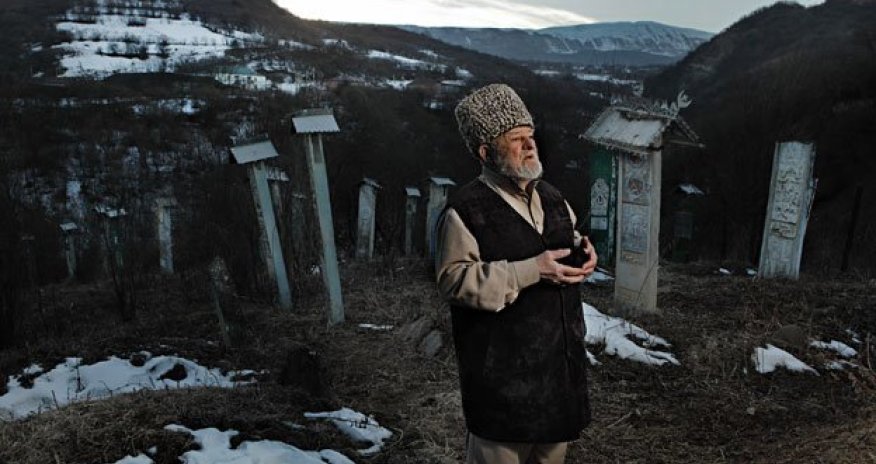


"At dawn, five soldiers entered each house and took all the men away - anyone over the age of 14. I was 10 years old. Then they said they would deport all of us," says Isa Khashiyev."We had 10 people in our family - mum and dad, grandmother and seven children. I was the eldest, and my youngest sister was three months old."The soldier who was assigned to deport us was very kind. He loaded our truck with five sacks of grain and helped us pack our bedding and other belongings. It was thanks to him that we survived," he says. The truck took them to the nearest railway station in Ingushetia where they were put in a cattle wagon with 10 other families.Khashiyev's family was sent on a 15-day journey to Kazakhstan. "We had no water and no food. The weak were suffering from hunger, and those who were stronger would get off the train and buy some food. Some people died on the way - no-one in our carriage, but in the next carriage I saw them taking out two corpses."It was cold and dark when they arrived in Kokchetav, in the plains of northern Kazakhstan. "We went off on a sledge, I fell off at one point, but they stopped the sledge and my mum ran back to find me," says Khashiyev."Our baby sister died that night. My dad was looking for a place to bury her - he found a suitable place, dug the grave and buried her… she must have frozen to death."The exiles were housed by local families, not all of whom were happy with the situation. "The landlady didn't want to let us in - she had heard that we were cannibals or something like that," he says. "Eventually she agreed to take us in, but she wouldn't speak to us."Khashiyev is one of nearly 100,000 Ingush who were deported - nearly 400,000 Chechens were exiled at the same time. Both had a long history of resistance to outside authority. Soviet leader Joseph Stalin suspected them of collaborating with German forces as they pushed south into the Caucasus in 1942 and 1943.Other nationalities deported en masse included the Balkars and Karachai, also from the North Caucasus, the Kalmyks, whose territory borders the Caspian Sea, the Crimean Tatars and, from the South Caucasus, the Meskhetian Turks.Exiles who survived the difficult journey east had to abide by strict regulations curbing their movement. They had to report to the authorities regularly and if they broke the rules they risked lengthy prison sentences in labour camps where conditions were even worse.The NKVD or secret police were the eyes and ears of the government and kept a close eye on the deportees. But some NKVD officers - like Alaudin Shadiyev, who had fought against the Nazis, but was deported along with all his compatriots - found this very tough.I was upset, very upset. I used to cry every night. And I did my best to help my people, and also to help the secret police," he says.Shadiyev's job was to check up on the exiles but he was horrified by the conditions he found at one deserted orphanage."I was asking, 'Where are all the children?' And someone waved in the direction of the forest… and under the trees I saw lots of babies lying on straw. Then a teenage girl came up to me, and more girls joined her, they were all about 12 years old, or younger."The eldest pointed to the babies lying around, some on rags, some on the straw, and they were stretching their arms towards me… they were asking for help."The girls had to forage in the fields and orchards or beg for food. "All these children were dying in silence. It was too hard for me to witness this. Even today I can hardly speak about this," says Shadiyev.The deportations were a taboo subject under Stalin - the Soviet leader died in 1953 and the exiles were not allowed to return home until 1957. Khashiyev is now 80 and lives back in his native village where he is one of the elders. Shadiyev is 94 and lives near Nazran, the capital of Ingushetia.(BBC)ANN.Az






Latest news 
More news

 Photo
Photo 


 Video
Video