





Our scorched Earth in 2100
17.06.2015 10:30


It looks like the world could be a much hotter place by the end of the century.
New data released by Nasa scientists is revealing how temperature and rainfall patterns around the world may change by the year 2100.
Using climate change predictions based on increasing levels of carbon dioxide, the data reveals what may happen to the climate in individual towns and cities.
Much of the data is still in raw form for now to allow scientists to run models on a daily timescale.
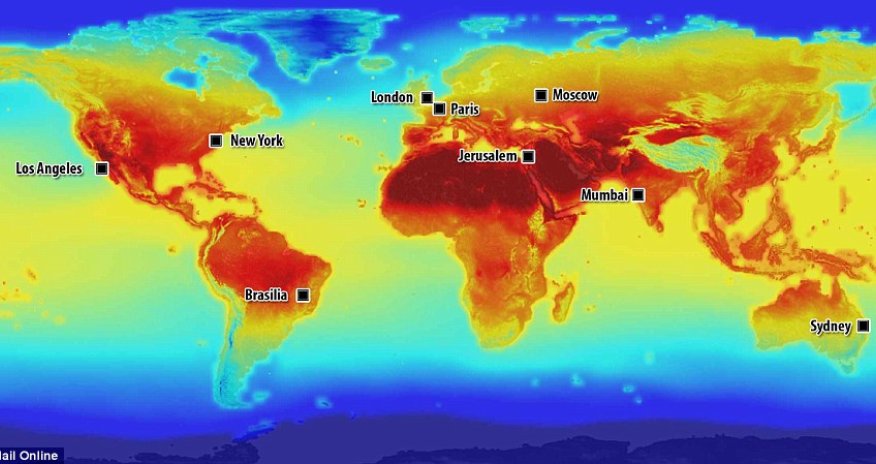
However, a map of the world released by Nasa, which shows the predicted temperature for July 2100, provides some clues for what the world may look like.
By that time, carbon dioxide levels in the atmosphere will have reached 935 parts per million, meaning the gas comprises nearly 0.1 per cent of the atmosphere.
Earlier this year carbon dioxide levels reached 400 parts per million.
If by the end of the century carbon dioxide in the atmosphere more than doubles, much of Africa, South America and India will endure average daily maximum temperatures of more than 45°C.
Jerusalem, New York, Los Angeles and Mumbai could see summer temperatures reaching these levels too.
London will experience temperatures in the mid 20s and Paris could see its July temperatures reaching the low 30s.
Ellen Stofan, chief scientist at Nasa, said: 'Nasa is in the business of taking what we've learned about our planet from space and creating new products that help us all safeguard our future.
'With this new global dataset, people around the world have a valuable new tool to use in planning how to cope with a warming planet.'
The new dataset is the latest product from Nasa's Earth Exchange (NEX), a big-data research platform within the NASA Advanced Supercomputing Centre its Ames Research Center in California.
The data shows projected changes worldwide in response to rising carbon dioxide levels and can be viewed on a daily timescale for individual towns and cities.
Unlike other climate prediction maps, which tend to show how global temperatures will differ from a pre-industrial average or current levels, the data gives predicted values.
Nasa says the data will help scientists and planners better understand the risks facing the world due to climate change.
It may also allow them to better plan for climate related hazards such as drought, floods, heatwaves and losses in agricultural productivity.
An earlier set of data released by Nasa in 2013 providing climate projections for the United States is already being used to calculate risks to the nation's agriculture, forests, rivers and cities.
Dr Ramakrishna Nemani, Nasa's Earth Exchange project scientist, said: 'This is a fundamental dataset for climate research and assessment with a wide range of applications.
'Nasa continues to produce valuable community-based data products on the Nex platform to promote scientific collaboration, knowledge sharing, and research and development.'
Nasa's new data, which totals more than 11 terabytes, integrates actual measurements from around the world with data from climate simulations.
It provides both rainfall and temperature projections at a resolution of around 15.5 miles (25km), between 1950 and 2100 across the entire globe.
The map shows that much of North Africa, India and equatorial parts of South America will face summer temperatures in July that regularly exceed 45°C.
Exactly how much this differs from current temperatures is not clear as Nasa has not released maps showing comparative temperatures.
However, daily average high temperatures in Africa, for example, can reach 47°C in July although the daily mean temperature is around 39°C.
For those with the computing power and hard drive space, the data can be downloaded here.
(dailymail.co.uk)
www.ann.az


Instagram
Follow us on Instagram
Similar news
Similar news





Society 13:30
Students Without Final Academic Evaluation Ineligible for School Diplomas — Deputy Minister







 Photo




 Video


