





Online activism signals place of next revolutions
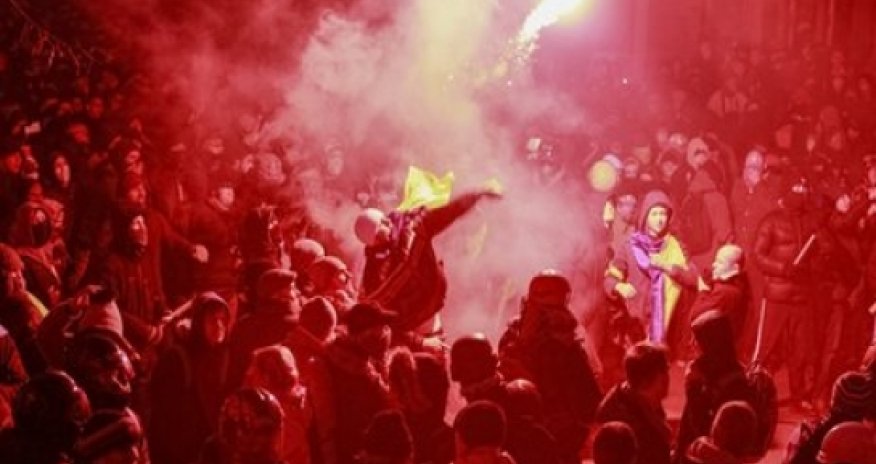


Online activism can be an accurate indicator of where revolutions might take place next, according to University of Manchester research.
Argentina, Georgia, the Philippines and Brazil are claimed to be most at risk of upheaval, according to this measure.
The Revolution 2.0 Index was developed last year and identified Ukraine as the most likely to see political upheaval.
This index sees revolution being forecast by computer experts rather than political analysts.
The index was designed as a teaching tool by Prof Richard Heeks, from Manchester University's Centre for Development Informatics, which looks at how data and information technology interact with society.
It provides a different view of how regimes are put at risk by protest movements, looking at online factors rather than street demonstrations.
The index produces a risk factor based on the level of repression and the ability of people to organise protests online.
According to this measure, there is a lower level of risk of revolution in repressive countries with tight controls over the internet.
The highest risk comes in countries where there are protests against perceived injustices - but where there is relative freedom online.
Prof Heeks says his index shows the variables in the impact of online activism.
The combustible mix of perceived oppression, alongside the ability for dissidents to organise on the internet, pushed some countries to the top of the index.
Ukraine headed the list in 2013 - but is now followed by Argentina, Georgia, the Philippines and Brazil, as the places most likely to face upheaval.
Also high on the list are countries such as Kenya, Nigeria and Azerbaijan.
At the lowest end of this 39-country index are countries such as Iran, Cuba and China.
The index was developed in the wake of the Arab Spring, which was linked to the use of Facebook and other social networking websites.
It was intended as a way of teaching rather than a "predictive tool", but it showed that Ukraine was the most likely regime to face revolution.
"In Ukraine, the international media has focused on mass protest, shootings, ransacked buildings, stand-offs with Russia," said Prof Heeks.
"But social media has been the core tool used to organise protests and maintain them by letting protesters know where they can get nearby food, shelter, medical attention, and so on.
"It has spread word about violence and has garnered support and assistance from overseas."
Prof Heeks says revolutions are a result of "highly complex factors that no simple calculation can hope to reflect let alone predict".
But he says that the index does show the differences in how political protests are able to develop and organise online.
This also raises the prospect of regimes under pressure wanting to take more restrictive control over online activity.
"Many regimes are indeed doing just this, making cyberspace a domain for control and surveillance of opposition supporters," he says.
(BBC)
ANN.Az






 Photo




 Video


