





Is the Internet broken, and can it even be fixed?
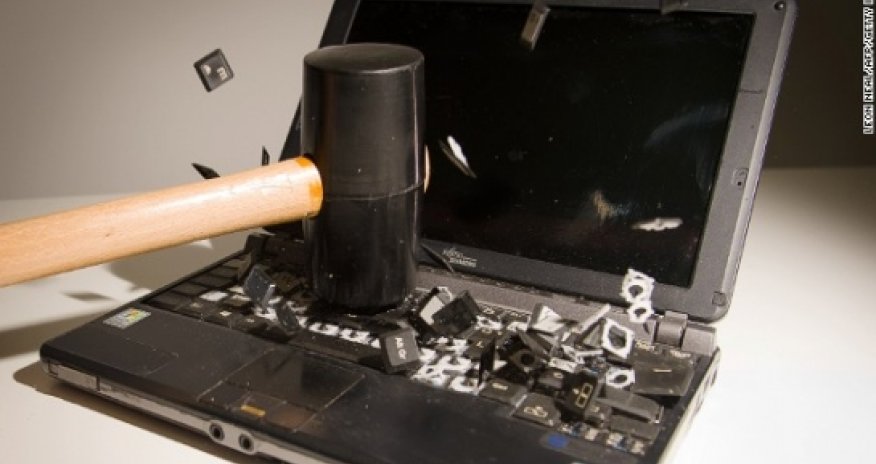


We have faster computers, more storage space, and more people using the network, but worryingly, some of the key assumptions haven't changed.As an example, take the protocol that helps determine how data gets to its destination. Different networks in the Internet "advertise" routes to deliver data to other networks, with the most efficient candidate being chosen.In early 2010, a mistaken advertisement from China Telecom caused a small but significant proportion of global Internet traffic to be mistakenly routed through China.Concerns such as these were not foreseen by the early designers; back then, the Internet was operated by people who knew and trusted each other.The same cannot be said today.Growing biggerThe increase in the size of the Internet recently caused a number of key machines in the infrastructure to run out of memory.The fix for this was relatively simple but, crucially, required those machines to be rebooted.While turning our home machines on and off is relatively low-risk, doing the same with a device that handles connections for thousands of users, and which may not have been rebooted for 20 years, is of much greater concern.The Internet is not some mathematical abstraction. It is a physical, evolving system that is constantly changing according to the demands that we place on it.As such, much of the Internet is, in some senses, "broken," and will continue to be so.As we fix or paper over certain aspects, the network changes and we discover new issues. The Internet, just like human laws, governments, and societies, is an evolving process rather than a static solution.From the startAt the end of the 1960s, an obscure research project to allow remote access to computing resources was funded by the U.S. Department of Defense.This "ARPANET" had to contend with multiple users accessing mainframe computers over unreliable communication links. While the wires that carried information were reliable, the computers in the network weren't.The first attempt to send a "login" command in 1969 caused the receiving computer to crash on receiving the letter "g."To overcome this unreliability, the early ARPANET used a revolutionary approach to sending data: rather than reserving a dedicated line between computers, as in a telephone system, all data was broken into "packets" that could be sent independently from place to place.If a single packet was lost or misdirected, this could be detected and retransmitted.This design was not, as commonly believed, chosen to provide robustness in case of a nuclear war. It was, in fact, solving a far more subtle problem: persistent, unpredictable, systemic failures.The ARPANET was the seed that, with much mutation and accretion, grew into the modern Internet.That core idea, to work around unreliability, now underpins the communications of billions of users around the world.The Internet was built on an "end-to-end" principle: that the network itself should be as unintelligent as possible, and should focus purely on getting data from point to point.Any other concerns, such as security, should be achieved at the "edges" of the network: our computers and smartphones.It's easy to change and improve the computers at the edge of the network, but it's very hard to change the underlying network itself.Constant evolutionSo is the Internet fit for purpose? In many ways, this is a meaningless question. We make the Internet to meet our purposes, and we improve it as it falls short of our expectations.In the future the Internet will need to develop technically to support its growing population and the rapid increase in connected devices, but it will also need to develop institutionally to support the needs and desires of developing nations that are massively underrepresented in the debates surrounding the Internet's governance and institutions.The Internet has shifted the way that much of humanity communicates and interacts on a global scale.Its development has been gradual and, in many ways, largely unplanned. The huge benefits that the Internet offers are increasingly balanced by concerns regarding balances of power, equality of access, centralization, security, and mass surveillance.What is crucial going forward, is that we guide the evolution of the Internet, as far as possible, towards the benefits it can offer rather than its risks.
(CNN)
Bakudaily.Az














 Photo
Photo 



 Video
Video