





Lasers reveal what taste LOOKS like
29.04.2015 13:37


The idea that your tongue is separated into ‘zones’ for different tastes has been widely debunked - although the exact process taking place is still poorly understood.
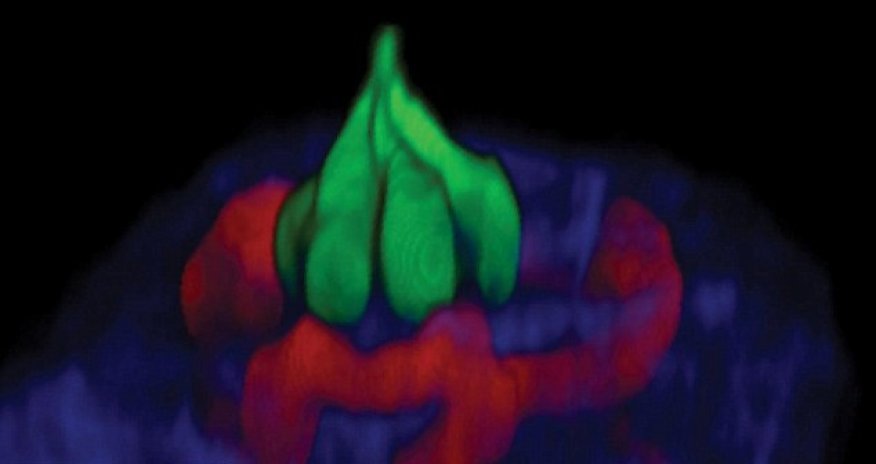
But now, for the first time, scientists have created a live imaging map of the tongue's taste buds to determine what happens each time we place food in our mouths.
It reveals how taste buds have different cells that are used to differentiate between between the five basic groups of flavours.
The research was conducted by an international team that included the Australian National University (ANU) and the Harvard Medical School.
They used a specially designed microscope system to image single cells on the tongue of a mouse.
Using a method called intravital multiphoton microscopy, the scientists were then able to pick out individual taste cells within each bud.
They were also able to spot blood vessels up to 240 microns - 240 millionths of a metre (0.0024mm) - below the surface of the tongue.
‘We've watched live taste cells capture and process molecules with different tastes,’ said biomedical engineer Dr Steve Lee, from ANU.
There are more than 2,000 taste buds on the human tongue, which can distinguish at least five tastes: salty, sweet, sour, bitter and umami - a word used to describe smooth and typically savoury, meaty sensations.
However, the relationship between the many taste cells within a taste bud, and our perception of taste, has been a long-standing mystery, said Professor Seok-Hyun Yun from Harvard Medical School.
‘With this new imaging tool we have shown that each taste bud contains taste cells for different tastes,’ said Professor Yun.
The breakthrough complements recent studies by other research groups that identified the areas in the brain associated with taste.
Interestingly, the results showed that taste cells respond not only to molecules contacting the surface of the tongue, but also to molecules in the blood circulation.
According to Assistant Professor Myunghwan (Mark) Choi from the Sungkyunkwan University in South Korea, this suggests tasting might ‘involve an interaction between the food taken orally and blood composition.’
The team now hopes to develop an experiment to monitor the brain while imaging the tongue to track the full process of taste sensation.
However to fully understand the complex interactions that form our basic sense of taste could take years, Dr Lee added.
‘Until we can simultaneously capture both the neurological and physiological events, we can't fully unravel the logic behind taste,’ he said.
The findings were published in the journal Nature.
(dailymail.co.uk)
www.ann.az


Similar news
Similar news











 Photo
Photo 



 Video
Video