

Liberia - the country that wants to privatise its primary schools
26.04.2016 15:01


Liberia has a radical plan to hand the running of all primary and nursery schools over to private companies and charities.
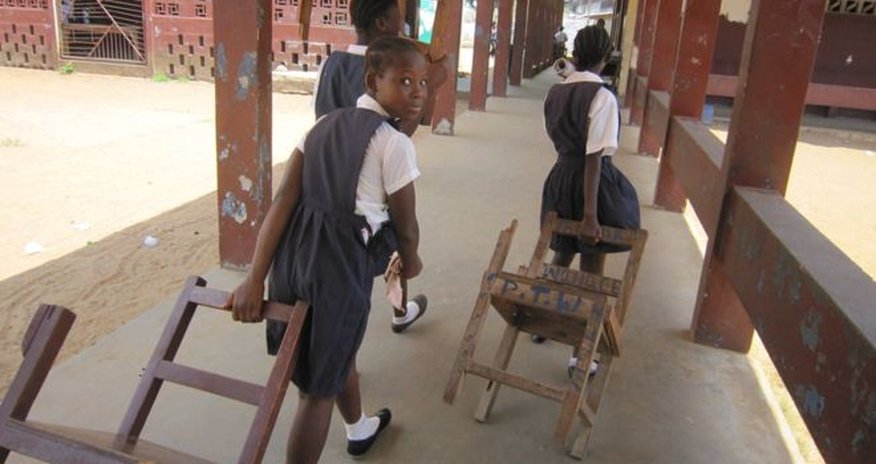
Observing a first grade lesson at a primary school on Somalia Drive in the capital, Monrovia, it is easy to see that changes need to be made.
Around 50 pupils are in the crowded classroom, some students have to stand because of a lack of chairs. The teacher is having difficulty being heard over the noise and there are not enough teaching resources.
The country's education system was branded "a mess" in 2013 by President Ellen Johnson Sirleaf after all 25,000 high school graduates that year failed to pass the University of Liberia's entrance examination.
Education Minister George Werner has been looking for a way to make a dramatic change in order to put the country's schools on a par with others in West Africa.
He admits that the education system has been "in a state of decay for the last three decades" as a result of years of conflict and the recent Ebola epidemic. He adds that "this doesn't mean that our children are not bright; [rather] the system is failing them".
He says he realised that a long-term gradual plan with the government in charge was not going to solve the problems.
So in a pilot project starting in September, 50 of the country's 5,000 primary schools are going to be taken over by the Kenya-based company Bridge International Academies.
Education will still be free for the parents, but the government will not be running the schools.
Bridge International Academies, which has 359 schools in Kenya and seven in Uganda, says that "the people of Liberia deserve better" than a system where only a fifth of primary school children finish secondary school.
'Success in Kenya'
It says it has already made a difference in Kenya through what it calls its "Academy-in-a-box" model.
Teaching materials are developed centrally and delivered by teachers off a tablet computer. The computers are also used to monitor how teachers and students are progressing, so any issues can be picked up quickly.
Bridge International Academies has published a raft of charts showing how in Kenya its schools out-perform government schools in maths and reading on nearly every measure.
It is easy to see how the education minister may have been persuaded to give the private company a chance, but some Liberian teachers are not convinced.
Joseph Komoreah, who teaches at a Monrovia primary school, called the plan to hand over the country's schools "a shame" as he argues that Liberians need to be in charge of their own education.
He thinks that one of the reasons for schools underperforming is the low salaries teachers are getting, which forces teachers to take up jobs in more than one school "and this is energy-consuming"."Liberians are qualified," declares his colleague Weah-dee Nyenkan. "Teachers are willing to do the work. We disagree when they say the children are not performing."
In the pilot programme, Liberian teachers will still be in the classroom and their salaries will be paid by the government. But they will be vetted and monitored by Bridge International Academies.
While the government is committed to paying the teachers, it says it is not paying any money to Bridge International Academies for it to take over the schools. The company says it is looking for funding elsewhere.
'Rights violation'
The plan to hand Liberia's education over to private hands has also angered the UN's Special Rapporteur on the right to education, Kishore Singh.
In March he said that "the concept of education as a public good [was] under attack".
"Provision of public education of good quality is a core function of the state," Mr Singh added. "Abandoning this to the commercial benefit of a private company constitutes a gross violation of the right to education."
But Mr Werner thinks this criticism "misses the mark" and is the result of only talking to the teachers' unions.
He agrees that the state has to guarantee certain things, like the right to a free primary education, however "those who think that the private sector has no role to play in the public provision of education are mistaken. I hope they can change their minds".
The battle to change people's minds will start in September when Bridge International Academies starts teaching its first batch of Liberian pupils.
If that goes well then the government will be looking for a host of private providers to radically change the country's education system.
(BBC)
www.ann.az


Telegram
Follow us on Telegram






 Photo




 Video


