





1,200-year-old Viking sword is found lying at the side of the road in Norway
24.10.2015 11:28


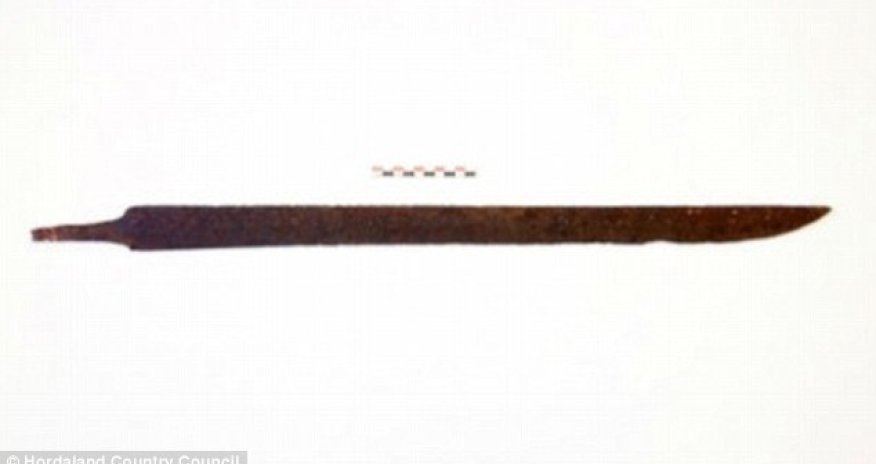
A hiker taking an old route across central southern Norway has stumbled across an ancient sword dating back to the Viking Age.
The wrought iron weapon was partially buried beneath rocks on a walking route in Haukeli and is 30-inches (77cm) long.
It is 1,200-years-old and an local archaeologist said that the weapon is in such good condition that if it was given a 'polish and a new grip' it would be strong enough to use today.
It was found by hiker Gøran Olsen on the border of Telemark in Haukeli and was examined by Jostein Aksdal, an archaeologist working for Hordaland County Council.
No further details are known about the well-preserved, double-edge sword and a team of experts, led by Mr Aksdal, is planning to excavate the area in the spring when the snow clears.
'It is unusual to find a sword of this type today,' said Mr Aksdal. 'It was a costly weapon, and the owner must have used it to show power.'
The Viking Age lasted for more than 300 years, between 700AD to the late 11th century.
Feared and revered for their violence, Vikings originated from Denmark, Norway and Sweden and the name comes from the Old Norse for 'pirate raid'.
Warriors often raided ships and their experience at sea led them to settle in other countries including the UK and Ireland.
Viking laws dictated that all free men were expected to own weapons, and these mainly included spears, swords and battle-axes.
They were carried for battle, but also used as status symbols.
As a result, their grips were often finely decorated silver, copper and bronze.
Swords were the most expensive to make and were a sign of high status.
Some of the earliest Viking blades were created using a technique known as pattern-welding, which involved forging wrought iron and mild steel.
Later blades were printed with specific marks, believed to have been the name of the maker, such as Ulfberht.
Although it is well-preserved and strong, the sword found in Haukeli doesn't bear the marks of these superstrong, 'Ulfberht' weapons.
Around 170 Ulfberhts have been found, dating from 800 to 1,000AD and they are made of metal so pure it has baffled archaeologists.
In particular, the technology needed to forge such metal was not invented for another 800 or more years, during the Industrial Revolution.
In the process of forging iron, the ore must be heated to 1,650°C (3,000°F) to liquify, allowing the blacksmith to remove the impurities, known as 'slag'
Carbon is also mixed in to make the brittle iron stronger.
Medieval technology did not allow iron to be heated to such a high temperature, so slag was removed by pounding it out, a far less effective method.
The Ulfberht, however, has almost no slag, and it has a carbon content three times that of other metals from the time. It was made of a metal called 'crucible steel.'
It was thought that the furnaces invented during the industrial revolution were the first tools for heating iron to this extent.
(dailymail.co.uk)
www.ann.az


Youtube
Follow us on Youtube


Similar news
Similar news







Society 13:30
Students Without Final Academic Evaluation Ineligible for School Diplomas — Deputy Minister



 Photo




 Video


