

• $
  • €
  • ₽
  • ₺
  • £

Scientists puzzled over mystery early humans that Neanderthals had sex with
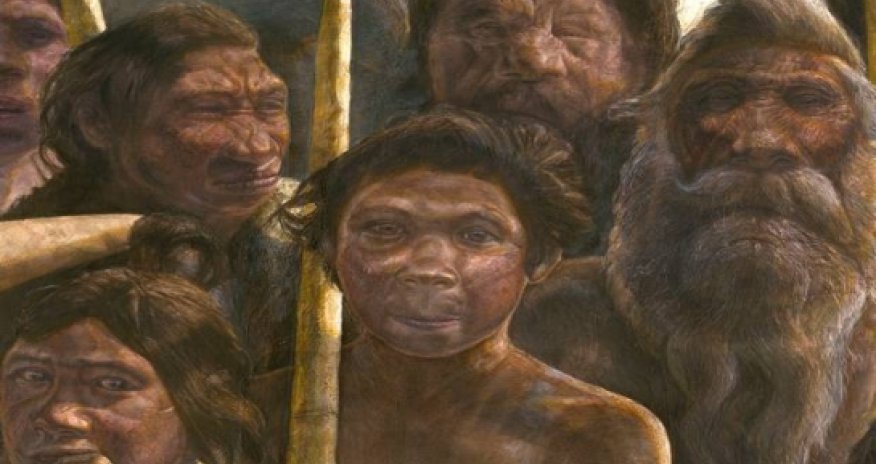
Scientists puzzled over mystery early humans that Neanderthals had sex with
05.12.2013 21:44

Scientists have extracted and sequenced the oldest human DNA. It came from a fossilised leg bone of an early human who died about 400,000 years ago in what is now northern Spain.

Its DNA sequence indicates that this early European was more closely related to a much earlier species of human living in Siberia about 700,000 years ago than to the later Neanderthals of Europe who became extinct about 30,000 years ago.The genetic link between early Europeans and even earlier Asians has surprised researchers who had expected to find a closer genetic relationship to the later Neanderthals, who had occupied Europe for tens of thousands of years before eventually dying out after anatomically-modern humans arrived.“It really raises more questions than it answers,” said Svante Paabo, the director the Max Planck Institute for Evolutionary Anthropology in Leipzig where the ancient DNA was extracted from the thigh bone of a skeleton excavated from the cave site known as the “pit of bones” in Sierra de Atapuerca.More than 28 human skeletons have been excavated from Sima de los Huesos cave, along with the bones of extinct animals such as cave bears dating back about 600,000 years, making it one of the richest sources of prehistoric fossils in Europe.Many palaeontologists believe that the femur bone used in the DNA extraction comes from an early “hominin” species known as Homo heidelbergensis, although other experts think that it is more likely to be a primitive ancestor of Neanderthal man.However, what has surprised the researchers is the relatively close similarity between the mitochondrial DNA of this Neanderthal-like European and the mitochondrial DNA of the Denisovans, a species that lived about 700,000 years ago in the Altai mountains of Siberia and known only from a small finger bone and two relatively large molar teeth.

“The fact that the mitochondrial DNA of the Sima de los Huesos hominin shares a common ancestor with Denisovan rather than Neanderthal mitochondrial DNA is unexpected since its skeletal remains carry Neanderthal-derived features,” said Matthias Meyer of the Max Planck Institute, who led the study published in the journal Nature.

DNA

One possibility is that the Sima humans were related to a population of early man that was ancestral to both the Denisovans and the Neanderthals. Alternatively, there could have been interbreeding with another group of humans who brought Denisovan-like DNA from Asia into the Sima people or their direct ancestors.Dr Paabo said that one way to resolve the conundrum over who was related to whom, would be to extract the nuclear DNA of the chromosomes, which is technically harder in fossilised bone than extracting the DNA of the mitochondria, which is inherited solely down the maternal line.“Our results show that we can now study DNA from human ancestors that are hundreds of thousands of years old. This opens prospects to study the genes of ancestors of Neanderthals and Denisovans. It is tremendously exciting,” Dr Paabo said.Juan-Luis Arsuaga, director of the Centre for Research on Human Evolution and Behaviour in Madrid, said: “The unexpected result points to a complex pattern of evolution in the origin of Neanderthals and modern humans. I hope that further research will help clarify the genetic relationships of the hominins from Sima de los Huesos to Neanderthals and Denisovans.”Professor Chris Stringer, head of human origins at the Natural History Museum in London, said that the unusual finding poses intriguing questions about the early origins of Neanderthals and their relationship with other humans living at that time.“It is exciting to see genetic material of this age being successfully sequenced. The mitochondrial DNA from a fossil femur found at La Sima de los Huesos or the Pit of Bones in Spain could be from around 400,000 years old. This represents the oldest human DNA material yet recovered,” Professor Stringer said.(independent.co.uk)ANN.Az
Twitter
Go
Similar news
Similar news
Weather Service Details Factors Behind Fog Across Baku and Absheron
Society 13:30
Weather Service Details Factors Behind Fog Across Baku and Absheron
Weather Forecast for November 4: Highs of 23°C in Baku, Up to 24°C in Lowland Regions
Society 12:56
Weather Forecast for November 4: Highs of 23°C in Baku, Up to 24°C in Lowland Regions
Over 150,000 Beneficiaries Received Special-Condition Pensions in October — SSPF
Society 12:30
Over 150,000 Beneficiaries Received Special-Condition Pensions in October — SSPF
Violations Uncovered in 24 Out of 80 Pharmacies Inspected in October — AEC
Society 17:00
Violations Uncovered in 24 Out of 80 Pharmacies Inspected in October — AEC
October Temperatures in Azerbaijan Exceeded Climate Norm by 3°C — Weather Service
Society 16:30
October Temperatures in Azerbaijan Exceeded Climate Norm by 3°C — Weather Service
Pashinyan: Opposing New Constitution Means Resisting Final Peace with Azerbaijan
Society 15:00
Pashinyan: Opposing New Constitution Means Resisting Final Peace with Azerbaijan
Over 4,800 Hectares Cleared of Mines in Liberated Territories in October — ANAMA
Society 14:00
Over 4,800 Hectares Cleared of Mines in Liberated Territories in October — ANAMA
Students Without Final Academic Evaluation Ineligible for School Diplomas — Deputy Minister
Society 13:30
Students Without Final Academic Evaluation Ineligible for School Diplomas — Deputy Minister
Armed Border Trespasser Neutralized After Firing on Azerbaijani Border Guards
Society 11:30
Armed Border Trespasser Neutralized After Firing on Azerbaijani Border Guards
Anews TV

Our official Youtube channel

Subscribe