




Georgia offers to host training camp for Syrian rebels


(This story has been updated.)
After significant public backlash, officials from the former Soviet Republic of Georgia denied a report on Tuesday that the country offered to host a center where the U.S. military could train Syrian rebels.
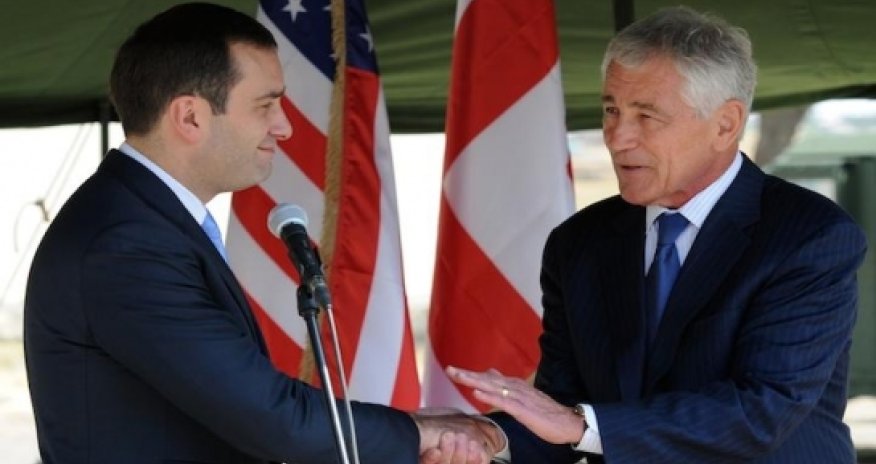
The offer, first reported by Foreign Policy, was made by Georgian officials to Defense Secretary Chuck Hagel during his visit to the country's capital of Tbilisi earlier this month, according to both U.S. and Georgian government officials. The Pentagon was considering the offer, however, after it became public on Tuesday and raised alarm bells about potential security issues for the small Caucasian nation, Georgian officials began to downplay, or in some cases, deny they ever offered.
"I categorically rule out any military participation or training base in Georgia. We have not discussed it and our American partners know it," Georgian Foreign Minister Maia Panjikidze reportedly told reporters in New York. Georgia's State Security and Crisis Management Council, an interagency body, stated that it was "not true" that the nation was planning on operating such a training camp, which could potentially put it in the crosshairs of the Islamic State and other militant groups.
Separately, Georgia's Defense Ministry did not deny the existence of the offer, and issued a statement saying it "is considering the ways how to contribute to the goals of anti-ISIS coalition in fight against terrorism."
The existence of the Georgian proposal was later reported by the Reuters news agency as well.
If pursued by the U.S. and Georgian governments, such a facility could have supplemented the White House's plan to train 5,000 Syrian rebels in Saudi Arabia to fight the Muslim extremists who control parts of Iraq and Syria. It would've also significantly elevated Georgia's role in the anti-Islamic State coalition as the United States and its Arab allies bomb militant targets in Syria. Georgia, which has cultivated close ties with Washington in the hopes of gaining membership into the North Atlantic Treaty Organization, has also sent troops to fight alongside American forces in Iraq and Afghanistan.
"[The training center] was something we offered, but is still under consideration," Georgian Ambassador Archil Gegeshidze told FP.
The potential scale of the Georgia-based training program was never clear, but Gegeshidze noted that it could host allied fighters from multiple countries, not just Syria. "It's a counterterrorism training center for any nationality," he said.
Later on Wednesday, Gegeshidze said his remarks were misconstrued. "My comment on this issue was misinterpreted because the topic of hosting a counterterrorism training center has never been negotiated by the Georgian Government," he said. "More so, I'm concerned that I was quoted without my permission."
During Hagel's trip, Georgia became the first country to sign onto the anti-ISIS effort outside of the "core coalition" of Australia, Britain, Canada, Denmark, France, Germany, Italy, and Poland.
The Pentagon on Tuesday wouldn't give a time frame for when it would decide whether to accept Georgia's offer.
"Georgia continues to demonstrate its commitment to promote and uphold peace and stability as it has in the past with strong support to international missions in Iraq and Afghanistan," a Pentagon official said, speaking on condition of anonymity.
Though Georgian officials never said they extended the invitation for a quid pro quo, there are a number of reasons the nation of just 4.5 million people would stick its neck out for Washington.
Like other southern Caucasus countries, Georgia fears that some of the region's many fighters who have taken up jihad in Syria and Iraq could turn on their homelands. To name one infamous example: Omar al-Shishani, a leading Islamic State commander, hails from Georgia's Pankisi Gorge region.
"If and when they come home, there could be a nasty blowback effect," noted Thomas de Waal, a Eurasia expert at the Carnegie Endowment for International Peace.
The offer was also in line with the goals of Georgian Defense Minister Irakli Alasania, a leading pro-Western figure in the government, who advocates for a Georgian security policy known by some as "unilateral NATO approximation."
"That means, even though there is no prospect of NATO membership, they have decided to do everything they can to be NATO outside NATO," said de Waal. That includes doing things like supplying significant troops to combat areas in Iraq and Afghanistan, sending peacekeepers to Mali, and now expressing willingness to host anti-ISIS fighters.
The United States has returned the favor by sending Marines to train brigade-sized Georgian units and providing political support for Georgia's eventual membership in the security alliance. Georgia also hopes to complete a deal to purchase Sikorsky-built Black Hawk helicopters.
"We fully support Georgia's ongoing defense modernization efforts," Hagel said earlier this month. "We want to and we will continue to help Georgia fulfill its Euro-Atlantic aspirations, including membership in NATO."
But joining the anti-radical Islamist coalition carries risks.
Islamic State militants beheaded British aid worker David Haines in a two-minute video titled "A Message to the Allies of America" it released on Sept. 14.
"For being a lapdog ... you will drag your people into another bloody and unwinnable war," warned the terrorist narrator.
Georgia also shares a border with NATO member Turkey, which itself is under ISIS attack. On June 11, terrorists stormed the Turkish consulate in Mosul, Iraq, kidnapping 49 employees and their family members. The men, women, and children were held in captivity until Sept. 19, when ISIS released them under murky circumstances.
Despite Georgia's Western outreach, it's unlikely to be invited into NATO anytime soon, if ever. The country's separatist enclaves of Abkhazia and South Ossetia are the primary obstacles. Russian forces invaded Georgia in 2008 and never left the two territories. Some members of the security alliance worry that Tbilisi's membership could eventually force NATO to engage with Russia militarily, due to the alliance's collective security vow requiring member states to come to the defense of fellow NATO members subject to armed attack.
Regardless, one NATO expert mused that Tbilisi's enthusiasm makes other NATO members look bad. "Just imagine how effective NATO would be if all of its current members contributed commensurate to the level of Georgia," said Damon Wilson, executive vice president of the Atlantic Council. "From providing among the most significant military contributions to operations in Afghanistan, to sensitive nonproliferation and intelligence cooperation, Georgia acts as a model NATO ally."
(Foreign Policy)
Bakudaily.Az







 Photo
Photo 

 Video
Video