





Migrant crisis: What next for Germany's asylum seekers?
09.09.2015 11:00


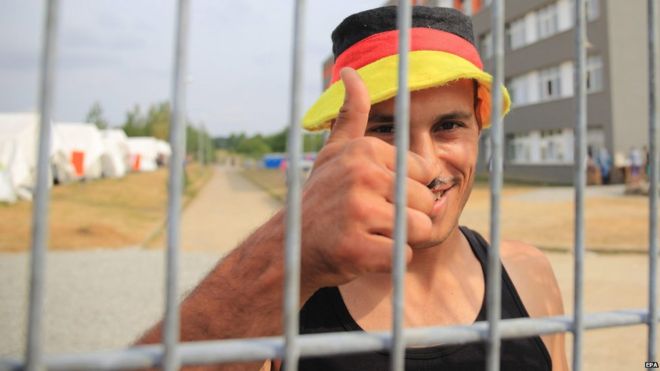
As large numbers of migrants and refugees travel to Germany in the hope of a new life, BBC News looks at how the country deals with such arrivals and its modern experience of migration.
What happens to asylum seekers on arrival?
The exhausted-looking people getting off trains in Munich and other German cities are being offered assistance then taken to initial reception centres.
Will they all stay in Munich?
No. The "Koenigsteiner Key" is used to distribute asylum seekers across Germany's 16 federal states, calculated according to their tax revenue and their population.
For example, North-Rhine Westphalia, Germany's most populous state, should take 21% of all asylum seekers, while Thuringia, the focus of several attacks on asylum accommodation, is set to receive under 3%.
An application for asylum is made at the reception centre on arrival, where personal details, fingerprints and photographs (for those over 14) are taken. A temporary permission to stay is granted.
Subsequently the asylum seeker will be invited to an interview to decide his or her case.
The current average time from application to decision is 5.3 months, according to the German government.
If granted refugee status, a residence permit for three years will be granted. After this time a permanent residence permit can be applied for.
More details are available from the Federal Ministry for Migration and Refugees (BAMF).
Who gets rejected?
Germany designates all EU states plus Ghana, Senegal, Serbia, Macedonia and Bosnia-Herzegovina as "safe countries of origin" - which means that asylum claims from nationals of these countries are likely to be rejected.
On 7 September the government announced that Kosovo, Albania and Montenegro would be added to this list.
Manfred Schmidt, President of BAMF, told Der Spiegel in August that 40% of all asylum seekers in Germany came from the Balkans, and their claims were likely to be unsuccessful.
Asylum seekers stay at reception centres for up to six weeks, and a maximum of three months.
After that they are offered either communal accommodation, or housed individually, depending on the policy of the federal state.
Asylum seekers who are unable to support themselves financially "receive what they need for their day-to-day life", the German government says.
Support varies from state to state, but generally includes non-cash benefits covering food and accommodation costs, plus limited spending money.
Are asylum seekers allowed to work?
All asylum seekers are banned from working for three months.
After this period, they may, with the permission of the immigration authorities and the Federal Employment Agency, take on work, subject to various restrictions.
Those given a residence permit have unrestricted access to the labour market after four years.
What is modern Germany's experience of migration?
In the immediate aftermath of Germany's defeat in World War Two, large numbers of ethnic Germans found themselves on the move.
Millions were displaced from areas of present-day Poland, Russia and the Czech Republic as Germany's boundaries were re-drawn. The Potsdam conference in July 1945 also ordered that ethnic Germans be "transferred" from areas of Poland, Czechoslovakia and Hungary where some communities had been settled for centuries. Ethnic Germans also left homes in Romania and the former Yugoslavia in the post-War period.
In total around 13 million ethnic Germans had to find a new home in West or East Germany.
In addition, almost 4.5m ethnic German resettlers from the former Soviet Union and Eastern Europe have arrived since 1950.
The booming economy of post-war West Germany required more workers, and from 1955 the Federal Republic signed "guest worker" agreements with Mediterranean countries such as Italy, Spain and - most significantly - Turkey.
Around 14 million guest workers and their families have come to Germany since 1955.
People of Turkish descent make up Germany's largest ethnic minority.
Initially the German government and the workers themselves planned for their stay to be temporary, and little effort was made to integrate them into wider German society.
(BBC)
www.ann.az


Telegram
Follow us on Telegram







 Photo




 Video


