





Time for American consistency in post-Soviet era - THE HILL
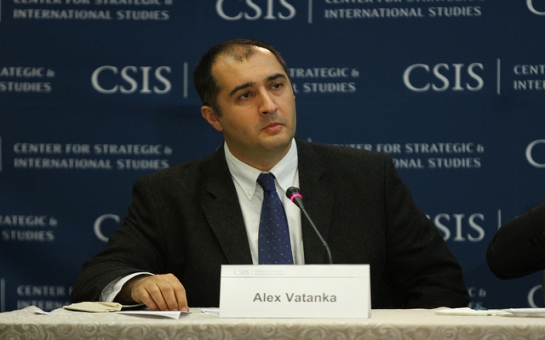


At a time when the direction of America’s foreign policy is generating abundant global bewilderment, policy-makers in Congress and the administration must be mindful not to alienate more allies and increase doubt and distrust of America’s promises. Azerbaijan, a pro-American, secular Muslim and energy-rich nation of some 9 million people on the shores of the Caspian Sea is one of those countries. Authorities in Baku are increasingly speculating about Washington’s commitment to its strategic allies and its own stated values. Some of America’s latest policy maneuverings, including an inconsistent and largely toothless response to Russia’s actions in Ukraine, have not helped alleviate Baku’s fears.Since its independence at the fall of the Soviet Union in 1991, the former Soviet republic of Azerbaijan has considered the United States as one of its principal strategic partners. This conscious, but at times hazardous, choice to turn to Washington was from the outset rooted in a belief in American strength and a hope in Washington’s fairness in mediating among disputing nations. It was a conviction that drove successive Azerbaijani governments to accept American arbitration in Baku’s conflict with neighboring Armenia over Nagorno-Karabakh, an Azerbaijani region occupied by Armenian forces since the end of a war in 1994.For 20 years, Azerbaijan has patiently stuck to this belief in America as the foolproof arbiter that will somehow and someday help engineer a peaceful resolution to this frozen conflict in the South Caucasus. Increasingly, however, the Azerbaijanis question whether the United States prioritizes short-term goals over long-term objectives of peace making and the upholding of key American values, including respect for the territorial integrity and sovereignty of nations.Azerbaijan’s anxieties about Congress and the administration’s stance on the Nagorno-Karabakh conflict recently surfaced again following Russia’s annexation of Crimea in March. Officials in Baku quickly grasped the possible impact of Moscow’s actions on the fate of other forcefully annexed territories, including Azerbaijan’s Nagorno-Karabakh region. In a bold step that could have not failed to irk its larger neighbor, Azerbaijan voted against Moscow in a UN vote that called the annexation of Crimea an illegal act, while many of the post-Soviet states abstained and Armenia, along with only 10 other questionable nations voted against the West.The Azerbaijanis have since also eagerly watched America’s posture toward Moscow in the hope that Washington will lead a broader push to stop Russian intimidation of her smaller neighbors and Moscow’s disregard for the territorial integrity of other countries. At a minimum, Baku had hoped that the United States would adhere to the same principles when adopting policies to deal with international territorial disputes. American policy-makers in Congress and the Executive, however, seem more preoccupied with scoring symbolic geopolitical points against Moscow than applying international laws on the question of territorial integrity of states.This was the case with a recent American measure at the OSCE’s Parliamentary Assembly in Baku. On 1 July, Sen. Benjamin Cardin (D-Md.) introduced a resolution that condemned Russian annexation of Crimea. Russia predictably voted against the resolution, and pro-U.S. Azerbaijan, which hosted the event, was not enthusiastic about the measure either. The territorial integrity of Ukraine is important, the Azerbaijanis argued, but a selective approach by the international community to territorial disputes will in the long run only make mockery of international law. Cardin’s resolution was a mere knee-jerk reaction to a phenomena – the disregard for territorial integrity of states – that impacts a number of post-Soviet states. It is not just Ukraine and Azerbaijan, but also an issue that Georgia and Moldova are wrestling to address. Along with Azerbaijan, the resolution failed to mention Georgia and Moldova as well. As the head of the Azerbaijani delegation, Bakhar Muradova, put it, a “serious resolution, which would concern all conflicts in the region,” will have been far more fitting given American leadership. Incidentally, such a selective approach best demonstrated by the EU’s refusal to emphasize Azerbaijan’s territorial integrity in its proposed association agreement with Azerbaijan, in stark difference with agreements offered to Georgia, Moldova and Ukraine, is one reason why Baku is still hesitant to move forward with the EU association. It is one thing to pursue a muddled foreign policy that leaves U.S. allies puzzled; it is an entirely different proposition – and with potential grave consequences for America’s global leverage – when Washington’s policies foster a sense of American double standards or its undependability as a partner.Vatanka is a senior fellow at the Middle East Institute and at the Jamestown Foundation in Washington D.C. He is also a senior fellow in Middle East Studies at the U.S. Air Force Special Operations School (USAFSOS) at Hurlburt Field and teaches as an adjunct professor at DISAM at Wright-Patterson AFB.Bakudaily.Az










Latest news 
More news 
 Photo




 Video


