Fire Phone: Can Amazon make us fall in love with 3D?
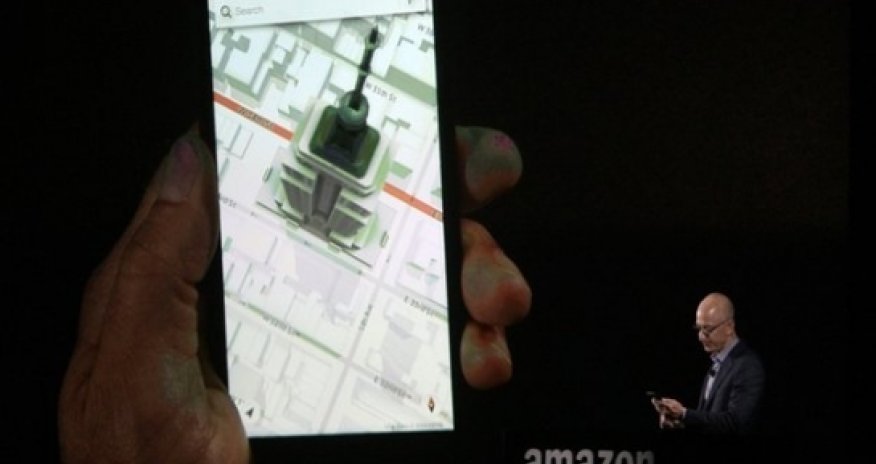


A series of failures have led handset-makers to all but abandon 3D tech. Could the US giant finally make us desire the extra dimension in our daily tech-interactions?If history is anything to go by, Jeff Bezos' company will have to overcome significant hurdles.In the early 1890s, British film pioneer William Friese-Greene filed a patent for a novel stereoscopic technology.More than 120 years later, 3D, as the viewing process has become known, is still not a household phenomenon, despite enjoying some recent success on the silver screen.Previous attempts to introduce 3D phones have failed spectacularly, partly because "they haven't solved any problem that consumers have," explains Avi Greengart, a consumer device expert for Current Analysis.Early failuresBack in 2002, Sharp unveiled a mobile phone that could convert pictures to 3D - which were viewable without pesky 3D glasses - thanks to its use of a technology developed in the UK.It used a technique called the parallax barrier. Simply put, it directed slightly different images to each eye, creating a 3D effect, albeit a fairly mundane one.A trickle of subsequent 3D phones failed to make a splash, and manufacturers all but abandoned the idea.Until, that is, James Cameron's Avatar movie - a 3D spectacular - became the highest grossing film of all time, taking in almost $2.8bn (£1.6bn) worldwide after its release in 2009.3D phones from HTC, LG, and once again Sharp, soon followed - but they too were met with a large shrug.Some blamed the lack of sharing capabilities, as only friends with 3D handsets would be able to receive pictures or videos from the devices.Others identified the paucity of apps on the devices, with few developers taking the opportunity to build specific programs for the 3D ecosystems, citing the lack of demand.3D or 2.5D?Amazon hopes to change all that with its latest offering. The Fire Phone doesn't send images flying off the screen, but rather uses pseudo-3D effects to enhance the experience of using a smartphone.Instead of sending different light to each eye, four front-facing cameras create "dynamic perspective," in which images on the phone change depending on the angle of the viewer's head.Unlike full-on 3D effects experienced when wearing glasses in the cinema, with Amazon's phone closing one eye does not spoil the illusion.This is a departure from the technology that powered Nintendo's 3DS console and other recent 3D smartphones.Users can also wave their hands to scroll through lists and play games where bending one's head makes you look around corners.3D maps are also included, in which models of buildings can be viewed by tilting the phone.But the Fire Phone still needs to overcome another hurdle which has plagued previous 3D smartphones - users finding the experience uncomfortable.Strikingly, some have even found the parallax effect triggered "simulation sickness", a phenomenon the US Army had encountered years previously when it used virtual environments in training.Even Apple's iPhone, which has no 3D capabilities, came under fire following the release of its iOS 7 mobile operating system because a subtle parallax effect was causing a small number of users to feel queasy.Dr Jenny Read, who researches stereo depth-perception at the University of Newcastle, explains that this might be down to how unaccustomed we are to 3D technology."We're used to watching TV, and viewing pictures," she says, "which is quite a subtle thing for your brain to do, but our eyes have learnt to correct disparate angles."However, she adds, "humans are very attuned to picking up subtle variations from reality" and 3D effects can "break our brains recipe for when to take things seriously".What 3D display manufacturers have to work out, says Dr Read, is "how much of a mismatch can we tolerate without experiencing discomfort".Moreover, as Maneesh Agrawala, a professor of computer science at University of California, Berkeley explains, inconsistency in 3D displays can be disturbing."There are a number of differences between the 3D you experience on a display and in the real world. The devices are creating an illusion of 3D, and that illusion can break around the edges."New tricksThe scientific challenge facing Jeff Bezos' new toy may be surmountable, but there is also a matter of convincing consumers that 3D is worth paying for.As Jackie Fenn, from tech research firm Gartner, says, "it's really a matter of whether 3D is useful enough, or aesthetically gorgeous enough".Getting users to adopt new interface technologies is specifically challenging, she adds."Take speech recognition. The technology is now pretty good, but we're not all talking to our computers."But previous failures of the nascent technology, and the fact that consumers are not clamouring for 3D phones, should not deter Amazon, says Ms Fenn, as those things "tends not to matter" when a product offers genuine value.Indeed, it may turn out that a smartphone will improve the 3D experience."On a smaller size display, the quality can be better, as it's easier to squeeze in more pixels," says Prof Agrawala.And, as Dr Read reminds us, many now ubiquitous technologies had teething problems."When cinema was first introduced, people found that very disturbing, and yet nowadays we all watch very happily," she says."There is a kind of circular effect - as the technology gets better, people will use it more."3D smartphones have long been heralded as an emerging technology, but as yet have never really emerged.Can Amazon's new phone break down the barrier?"If they get it just right it can take off," says Ms Fenn. "But they have to get it just right."(BBC)Bakudaily.az














 Photo
Photo 



 Video
Video