





Recipe for revolt: what do Ukraine, Turkey and Thailand have in common?
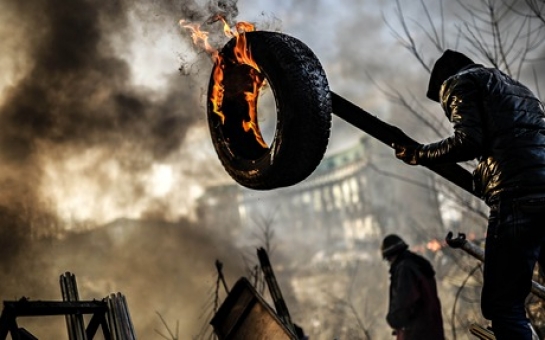


At the same time, it is plain that in the modern, interconnected world, grassroots uprisings cross-fertilise and often have similarities. Turkey, Ukraine, Thailand, Venezuela and Bosnia-Herzegovina are all middle-income democracies with elected leaders besieged by people angry at misgovernment, corruption and economic sclerosis. These days it is no longer just dictators who have something to fear from the crowd.The belief that violently propelled revolutionary change is transnational, even universal in nature, and uniform in origin and aspiration, is seductive, persistent and historically absurd. Its antecedents include the lost era of Marx and Lenin when the "workers of the world" espoused the dictatorship of the proletariat.Wordsworth's joyful reaction to the French revolution – "Bliss was it in that dawn to be alive, But to be young was very Heaven!" – , which he fondly believed threatened the ancien regime across all Europe, shows how lasting, powerful – and illusory – is the idea of ubiquitous, socially-levelling, personally liberating rebellion.Following this deceptive formula, the revolts that roiled the Arab world, starting in Tunisia in 2010, were initially lumped together under the optimistic tag of the Arab spring. This phrase is not often heard nowadays. The supposed pan-Arab battle for freedom and democracy, as it was wishfully interpreted in the west, mutated into a string of separately defined conflicts involving violent coup and counter-coup in Egypt, national fracturing in Libya, harsh repression in Bahrain and catastrophic civil war in Syria.In democracies in revolt, the differences are similarly instructive. Ukraine's uprising is increasingly taking on an ethnic tinge. The nationalist west against the ethnically Russian east. In Thailand, the principal animus is old-fashioned class warfare, pitting relatively well-to-do middle-class city dwellers against the subsidised rural masses. In Turkey, the primary focus of the protesters' rage has been one man, the prime minister, Recep Tayyip Erdoğan."While mayor of Istanbul, Erdoğan quipped that democracy was like a street car: 'You ride it as far as you need and then you get off.' He has proven himself a man of his word, as he has moved to consolidate power, eviscerate the judiciary, crush free speech, curb the media and imprison political opponents," said commentator Michael Rubin.Seen this way, Erdoğan appeared not so much a lesser version of Ukraine's Viktor Yanukovych - he has not, so far, resorted to shooting demonstrators - and more the Euro-Asian equivalent of Venezuela's Nicolás Maduro, who also stands accused of trampling civic freedoms. As in Thailand, Maduro's most vehement critics hail from the middle class who revile the so-called Bolivarian socialist revolution of his mentor, the late Hugo Chávez.As in Cambodia and Bangladesh, two other restless nations, a rapidly deteriorating economy, food prices and high crime rates are also key elements in unrest in Venezuela, said analyst Juan Carlos Hidalgo. "Despite receiving over $1tn in oil revenues since 1999, the government has run out of cash and now relies heavily on printing money to finance itself. The result is the highest inflation rate in the world." Venezuela is, however, no Ukraine, other analysts say.Another common denominator may be the peculiar position these countries occupy in the list of nations by wealth. Venezuela had a per capita GDP of $13,480 (£8,080) in 2012, placing it 73rd on the IMF's list. Turkey was 68th, with $14,812. Thailand was 92nd, Ukraine 106th. Although not exactly wealthy, groups who might be termed upwardly-mobile revolutionaries can afford the luxury of protest in a way previous generations in these countries could not.A mismanaged economy, corrupt privatisations, high youth unemployment and croneyism among the ruling elites also lay behind the recent, sudden eruption of violent protest in Bosnia. In this case, there was evident crossover with Turkey, and as in Bangkok, many Sarajevo residents have clearly lost confidence in their complex postwar political system. Despite its recent history, however, Bosnia's current grievances are economic, not ethnic."When Bosnia abandoned communism about two decades ago, officials devised a plan to privatise state-owned companies in a way they hoped would avoid mass layoffs for state workers," wrote Aida Cerkez."More than 80% of privatisations have failed. Many well-connected tycoons have swept into these companies, stripping them of their assets, declaring bankruptcy and leaving thousands without jobs or with minimal pay." Hence the anger on the streets.Ineffective, undeveloped or non-existent institutions, misgovernance, deteriorating economic performance, failing social cohesion, the alienation of younger generations, ethnic and nationalist tensions and a lack of faith in democratic processes – these are among the common factors sparking the rebellions of 2014.No one country or revolution is typical, but given these criteria, it is not hard to predict where unrest may next break out. Argentina is a prime candidate for trouble under the divisive, leftist leadership of President Cristina Fernández de Kirchner. Her increasingly anti-democratic stance, her government's corruption scandals and her efforts to deflect attention by picking fights with Britain over the Falkland s are ominous. Experience elsewhere suggests an economy in freefall and overseen by a nationalist demagogue is a recipe for revolt.(theguardian.com)ANN.Az








 Photo




 Video


