





Curiosity rover finds crater
28.05.2020 21:45


Billions of years ago, a lake once filled the 96-mile- (154-km) wide crater being explored by NASA’s Mars rover Curiosity, bolstering evidence that the planet most like Earth in the solar system was suitable for microbial life.
The new findings combine more than two years of data collected by the rover since its sky-crane landing inside Gale Crater in August 2012.
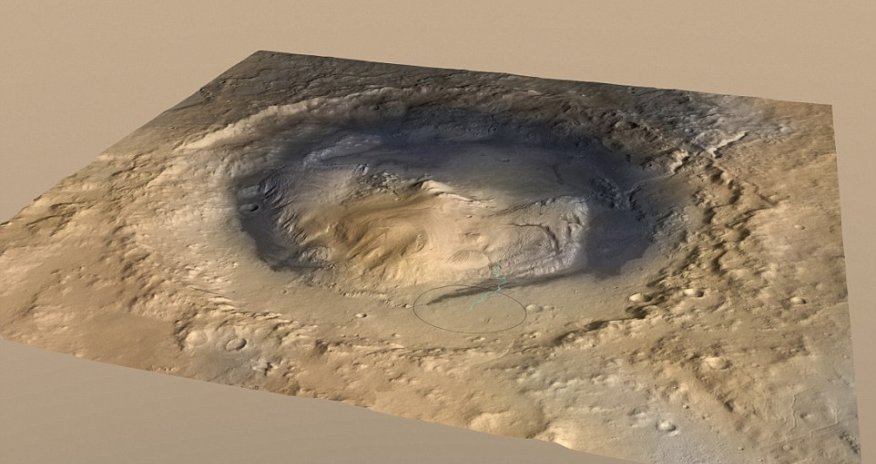
Scientists discovered stacks of rocks containing water-deposited sediments inclined toward the crater’s center, which now sports a three-mile (5 km) mound called Mount Sharp.
That would mean that Mount Sharp didn’t exist during a period of time roughly 3.5 billion years ago when the crater was filled with water, Curiosity researchers told reporters during a conference call.
Mars was also once an entirely wet and warm planet, with giant, long lasting lakes forming across its surface, the latest data from Nasa's Curiosity rover has shown.
This interpretation of Curiosity's finds in Gale Crater suggests ancient Mars maintained a climate that could have produced long-lasting lakes at many locations on the Red Planet.
'If our hypothesis for Mount Sharp holds up, it challenges the notion that warm and wet conditions were transient, local, or only underground on Mars,' said Ashwin Vasavada, Curiosity deputy project scientist at Nasa's Jet Propulsion Laboratory in Pasadena.
'A more radical explanation is that Mars' ancient, thicker atmosphere raised temperatures above freezing globally, but so far we don't know how the atmosphere did that.'
Researchers were baffled over why Mount Sharp sits in a crater.
Mount Sharp stands about 3 miles (5 kilometers) tall, its lower flanks exposing hundreds of rock layers.
The rock layers - alternating between lake, river and wind deposits - bear witness to the repeated filling and evaporation of a Martian lake much larger and longer-lasting than any previously examined close-up.
'We are making headway in solving the mystery of Mount Sharp,' said Curiosity Project Scientist John Grotzinger of the California Institute of Technology in Pasadena, California.
'Where there's now a mountain, there may have once been a series of lakes.'
(dailymail.co.uk)
ANN.Az
The new findings combine more than two years of data collected by the rover since its sky-crane landing inside Gale Crater in August 2012.
Scientists discovered stacks of rocks containing water-deposited sediments inclined toward the crater’s center, which now sports a three-mile (5 km) mound called Mount Sharp.
That would mean that Mount Sharp didn’t exist during a period of time roughly 3.5 billion years ago when the crater was filled with water, Curiosity researchers told reporters during a conference call.
Mars was also once an entirely wet and warm planet, with giant, long lasting lakes forming across its surface, the latest data from Nasa's Curiosity rover has shown.
This interpretation of Curiosity's finds in Gale Crater suggests ancient Mars maintained a climate that could have produced long-lasting lakes at many locations on the Red Planet.
'If our hypothesis for Mount Sharp holds up, it challenges the notion that warm and wet conditions were transient, local, or only underground on Mars,' said Ashwin Vasavada, Curiosity deputy project scientist at Nasa's Jet Propulsion Laboratory in Pasadena.
'A more radical explanation is that Mars' ancient, thicker atmosphere raised temperatures above freezing globally, but so far we don't know how the atmosphere did that.'
Researchers were baffled over why Mount Sharp sits in a crater.
Mount Sharp stands about 3 miles (5 kilometers) tall, its lower flanks exposing hundreds of rock layers.
The rock layers - alternating between lake, river and wind deposits - bear witness to the repeated filling and evaporation of a Martian lake much larger and longer-lasting than any previously examined close-up.
'We are making headway in solving the mystery of Mount Sharp,' said Curiosity Project Scientist John Grotzinger of the California Institute of Technology in Pasadena, California.
'Where there's now a mountain, there may have once been a series of lakes.'
(dailymail.co.uk)
ANN.Az


Similar news
Similar news










Latest news 
More news

 Photo
Photo 



 Video
Video